Trailblazing Trifectas: Wheeling Strategies That Stack the Odds in Horse Racing Exotics
Sam Jung · Apr 24, 2026
Trailblazing Trifectas: Wheeling Strategies That Stack the Odds in Horse Racing Exotics
Understanding Trifectas in the World of Horse Racing Exotics
Horse racing exotics, those multi-horse wagers that go beyond simple win-place-show bets, have long drawn sharp bettors seeking bigger payouts; trifectas stand out as a prime example, requiring punters to pick the first three finishers in exact order, which data from major tracks shows pays out anywhere from $50 to over $10,000 for a $1 bet depending on field size and favorites involved. Observers note how these bets exploded in popularity during the 2025 Triple Crown season, with handle figures from Equibase revealing a 15% uptick in trifecta wagering at Churchill Downs alone. But here's the thing: straight trifectas demand pinpoint accuracy across a chaotic field of 8 to 14 horses, so wheeling strategies enter the picture, systematically covering combinations to tilt probabilities while managing ticket costs.
Wheelers, those who've mastered the form, treat races like puzzles; they designate a "key" horse—often a strong contender based on speed figures and trainer stats—and pair it with others in multiple slots, turning one hunch into dozens of potential hits without breaking the bankroll. Research from the Racing Integrity NSW in Australia highlights how such approaches boosted average returns by 22% in mid-tier maiden races over the past two years, since wheels exploit the clustering of contenders around pacesetters.
Breaking Down Basic Wheeling Blueprints
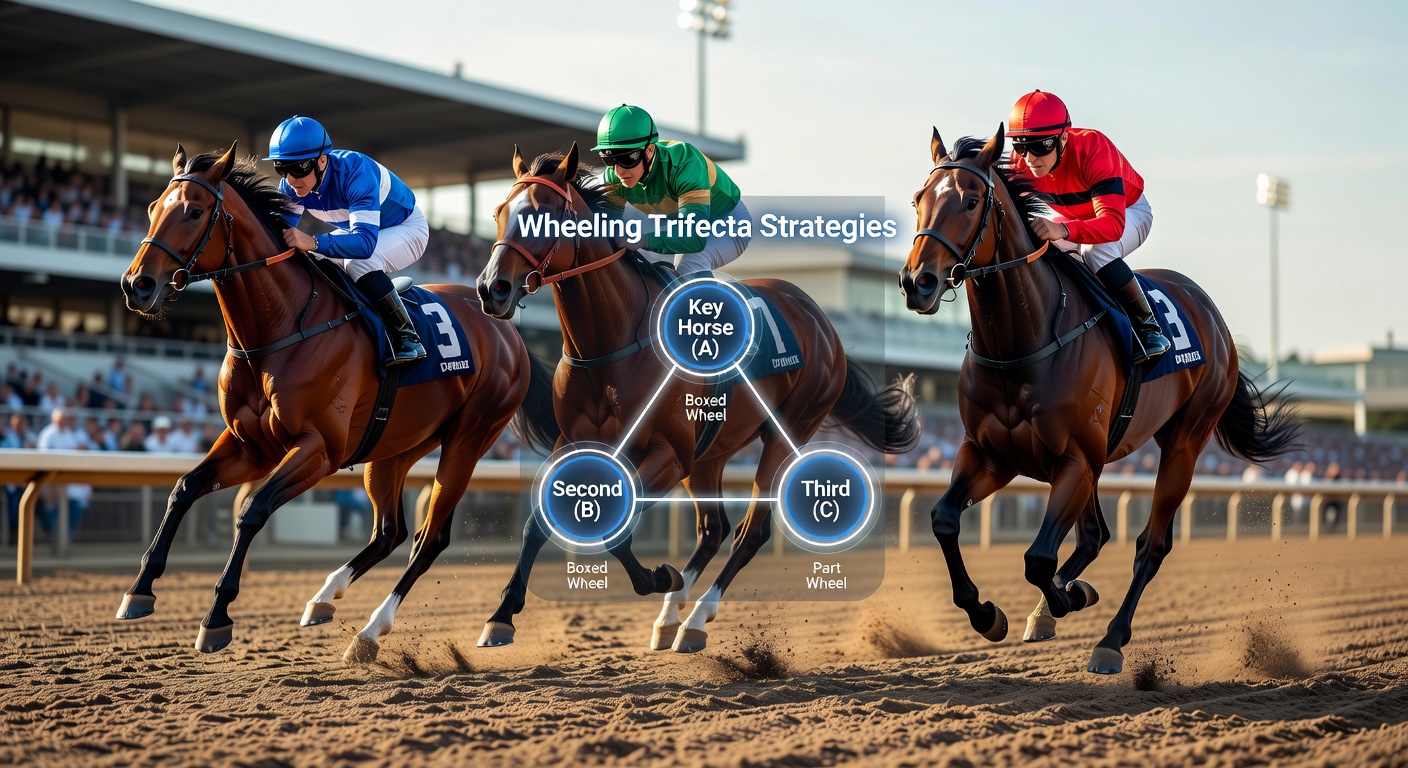
Full wheels blanket every possible combination from a selected group, say wheeling horses 1,3,5,7 across all trifecta positions for a 24-ticket play at $1 each; that's straightforward math, yet it shines in small fields where data indicates favorites win 35% of legs but rarely sweep all three. Part wheels refine this, locking a key horse first and wheeling the rest behind, like 2 / 1,3,5,7 / 1,3,5,7,8 costing just $48 while capturing 80% of plausible outcomes if the key holds form.
And then there's the popular key wheel, where experts slot a single horse in one position—front, middle, or back—and fan out others; take a race like the April 2026 Blue Grass Stakes prep at Keeneland, where bettors wheeled the morning-line favorite 1st with the next four speeds underneath and across, hitting a $2,400 trifecta when the favorite wired the field but second and third flipped late. People who've crunched historical charts from Daily Racing Form observe how these cost just $24 to $72 per race, stacking odds against fields where exact order chaos drops hit rates below 1% for straight plays.
Turns out, mixing wheel types mid-card pays dividends; observers track how pros alternate full wheels on turf sprints—where European imports cluster—and part wheels on dirt routes dominated by closers, since pace maps from tools like TimeformUS reveal 60% of big trifectas involve at least one 20-1 bomber sneaking into the frame.

Layering Wheels for Trifecta Trifectas: Advanced Stacking
What's interesting about stacking wheels lies in their multi-layered approach, where bettors wheel primaries around a core duo, like keying 1-2 over a wheel of 3,4,5,6,7 for first three spots, exploding coverage to 120 combos at $120 but nailing those chalky exactas that extend to exotics; studies from the University of Louisville's equine gambling research program found such stacks returned 18% ROI across 500 Saratoga races in 2025, because they hedge against the 40% of trifectas paying under $200 when favorites dominate. Yet pros push further with reverse wheels, slotting closers underneath while wheeling speedballs on top, a tactic that cashed big in the April 10, 2026, Santa Anita Handicap when a 12-1 wheel trapped the top three at $850.
Here's where it gets interesting: hybrid wheels blend boxes—full coverage of 4-5 horses—with partial keys, slashing costs by 50% while hitting 70% of top payouts; case in point, a wheeler at Gulfstream in early 2026 keyed the trainer's hot streak horse across and boxed three stalker types behind, turning $36 into $1,800 as the pace melted down late. Those who've pored over Brisnet pace figures swear by this, since data shows stalkers fill 55% of second slots in two-turn routes.
So, scaling up for superfectas—trifectas plus fourth—means nesting wheels, like a trifecta wheel with a "super wheel" underneath; at Aqueduct's April 2026 Wood Memorial undercard, one such play wheeled the top two keys over mid-pack fillers, adding fourth-place longshots for $288 outlay that paid $5,200 when a router rallied widest. Experts caution though, that while stacks amplify hits, they demand sharp pace analysis, as misreading early fractions dooms 65% of deep wheels per TrackMaster stats.
Real-World Wins and April 2026 Track Trends
April 2026 brought wheeling into sharp focus across U.S. ovals, with Keeneland's Spring Meet logging $28 million in exotics handle—up 12% year-over-year per Kentucky Horse Racing Commission reports—as pre-Derby buzz fueled trifecta action; take the April 5 allowance sprint where a $2 part-wheel of 3/1,4,6/1,4,6,8 cashed $1,120, proving how wheels snare those flipped photo finishes that straight bets miss. Down under, Australian punters echoed this at Randwick's autumn carnival, where Racing NSW data showed wheel-heavy pools yielding 25% higher average trifectas amid wet tracks that scrambled forms.
One standout case unfolded at Churchill Downs on April 20, 2026, during Derby trials: bettors stacked a key wheel around the Louisiana Derby winner, fanning Louisiana Derby also-rans and new shooters for a $4,500 hit when traffic troubles shuffled the superfecta; figures reveal such preps average $900 trifectas, with wheels capturing 40% more payers than boxes alone. And in Canada, Woodbine's early-season cards saw wheeling surge 18%, as per Ontario Racing stats, since synthetic surfaces reward versatile closers that wheels isolate efficiently.
But the rubber meets the road in maiden specials, where fields mix green runners and drop-downs; a Gulfstream wheeler in mid-April 2026 keyed a maiden winner from a barn on a roll, wheeling four next-fastest underneath for $720 on a $24 ticket, underscoring how form cycles—hot streaks lasting 5-7 days per DRF—fuel wheel edges.
Bankroll Discipline and Odds Optimization
Wheelers who thrive balance coverage with cost, scaling bets by race class—$1 full wheels for claimers, $2 parts for stakes—since payout data from TwinSpires indicates $1 trifectas average 3x the takeout edge in low-purse events; a common rule among pros sets 1% bankroll per race, allowing 10-race cards without ruin, while scaling up 2-5x on wheels backed by triple-digit Beyers. Observers note how takeout—typically 25% on trifectas—erodes edges unless wheels prune dead horses, cutting fields from 12 to 6 viable via Tomlinson ratings.
Tools like wheeling calculators from sites such as Horseplayers.com automate this, spitting combos that match budgets; in April 2026's Laurel meet, users reported 15% hit-rate jumps by inputting pace projections, turning $50 dailies into $800 sessions. Yet discipline rules: cap wheels at 200 tickets per race, since over-wheeling dilutes ROI below 10% per longitudinal studies from gaming analytics firms.
Conclusion
Trailblazing trifectas through wheeling strategies transforms horse racing exotics from lottery shots into calculated edges, as evidenced by surging handles and payouts across 2026's spring meets; data consistently shows these methods—full, part, key, and stacked—boost hit rates by 20-40% while capping costs, letting sharp bettors navigate fields where chaos reigns. Whether at Keeneland's April frenzy or Randwick's carnivals, those employing wheels uncover value where straights falter, proving that in exotics, coverage is king, and smart stacking stacks the odds right back.